
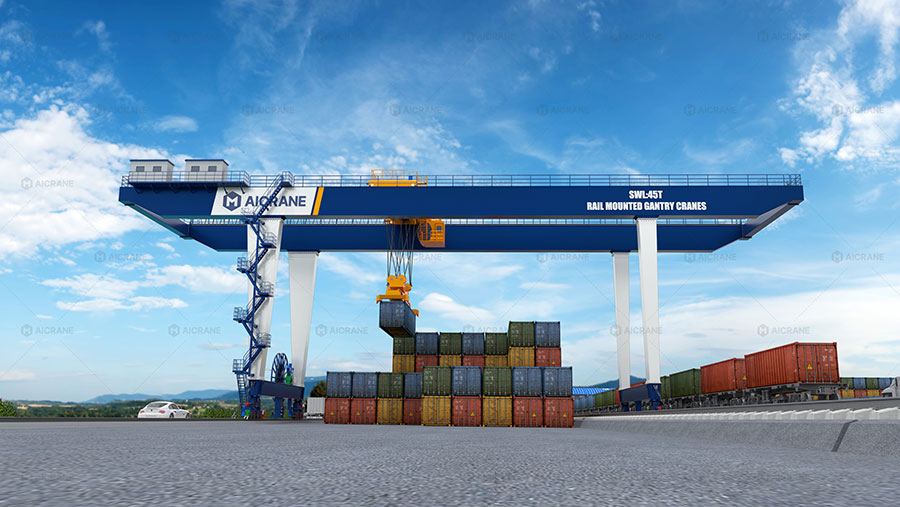
Rail Mounted Gantry (RMG) cranes are a core piece of lifting and handling infrastructure in modern ports, intermodal terminals, rail yards, and large industrial facilities. Unlike rubber tyred gantry cranes, RMG cranes operate on fixed rails, providing higher precision, stability, and suitability for heavy-duty and high-cycle operations.
Understanding the standard specifications of a Rail Mounted Gantry Crane is essential for project planners, engineers, procurement teams, and terminal operators. These specifications define not only lifting capacity and size, but also structural design, electrical systems, safety features, and environmental adaptability.
This article provides a comprehensive overview of the standard rail mounted gantry crane specifications, explaining what they typically include, why they matter, and how they relate to real-world operating requirements.
1. Rated Lifting Capacity Specifications
The rated lifting capacity is the most fundamental specification of an RMG crane. It defines the maximum safe working load (SWL) the crane can lift under standard operating conditions.
Typical RMG crane capacities include:
-
30–40 tons for industrial material handling
-
40–50 tons for single-container handling
-
65 tons (under spreader) for twin-lift container operations
-
Higher customized capacities for special loads or project cargo
Capacity specifications often distinguish between:
-
Rated load under spreader
-
Rated load under hook (if hook operation is required)
The capacity directly influences structural dimensions, hoisting mechanism selection, wheel loads, and foundation design. Over-specifying capacity increases cost, while under-specifying reduces operational flexibility and safety margins.
2. Span and Gauge Specifications
The span of a Rail Mounted Gantry Crane refers to the horizontal distance between the centerlines of the two rails. This dimension determines how many container rows or work lanes the crane can cover.
Common span ranges include:
-
15–25 meters for rail yards and industrial plants
-
25–35 meters for intermodal terminals
-
35–45 meters or more for container stacking yards
Closely related is the rail gauge specification, which defines:
-
Rail type (e.g., QU70, QU80, QU100)
-
Rail installation tolerance
-
Maximum allowable deviation in alignment and elevation
Span and gauge specifications must align with yard layout, container stacking strategy, and ground bearing capacity.
3. Lifting Height and Clearance Specifications
Lifting height specifies the maximum vertical distance the load can be raised from ground or rail level.
Standard lifting height considerations include:
-
Container stacking height (e.g., 1-over-5, 1-over-6, or higher)
-
Clearance above highest container stack
-
Allowance for spreader and lifting gear
Typical RMG lifting heights range from:
-
12–18 meters for rail-mounted industrial gantry cranes
-
18–25 meters for container yard RMG cranes
In addition to lifting height, specifications also define:
-
Under-spreader clearance
-
Maximum and minimum hook approach
-
Safe distance to structural components
4. Hoisting, Trolley, and Travel Speed Specifications
Motion speed specifications determine productivity and cycle time.
Hoisting Speed
-
Light load: higher speed for efficiency
-
Full load: reduced speed for safety and motor protection
Typical hoisting speeds range from 10 to 30 m/min depending on capacity.
Trolley Travel Speed
The trolley carries the hoist across the girder.
-
Standard range: 40–70 m/min
Gantry Travel Speed
Defines how fast the crane moves along rails.
-
Standard range: 60–120 m/min
These speeds are often controlled by Variable Frequency Drives (VFDs) to ensure smooth acceleration, reduced sway, and lower mechanical stress.
5. Structural Design Specifications
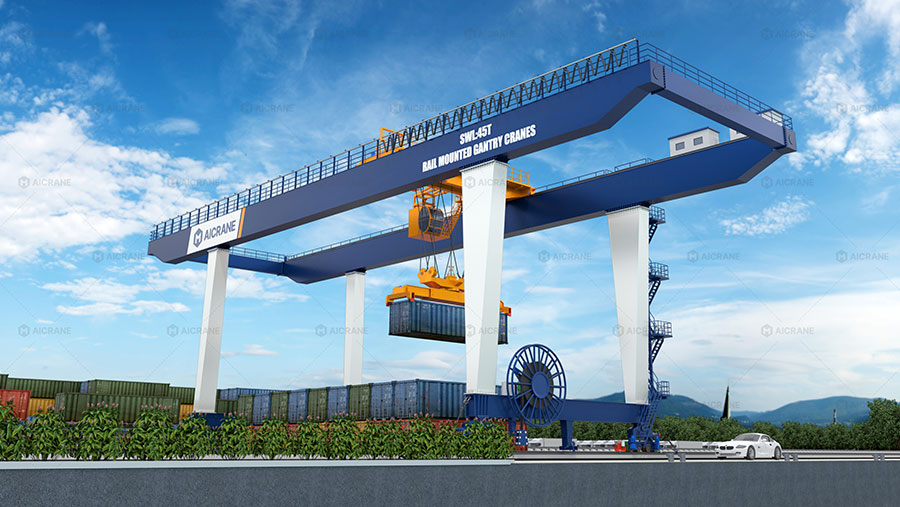
RMG crane structures are typically designed using box girder construction, which provides high torsional rigidity and long-term fatigue resistance.
Standard structural specifications include:
-
Single girder or double girder gantry crane configuration
-
Steel grade selection based on stress and climate
-
Deflection limits (e.g., L/700 or L/800 under rated load)
-
Allowable stress and fatigue class
The gantry legs may be:
-
Rigid leg + hinged leg configuration
-
Both rigid legs for high stability applications
Structural design specifications must comply with international standards such as FEM, ISO, or CMAA.
6. Wheel Load and Rail Load Specifications
Wheel load specifications are critical for rail design, foundation engineering, and long-term reliability.
Key parameters include:
-
Maximum static wheel load
-
Dynamic wheel load factor
-
Distribution of load across wheels
Typical RMG cranes use:
-
8, 12, or 16 wheel configurations
-
Double-flange or guide wheels for anti-derailment
These specifications directly affect:
-
Rail section size
-
Concrete beam reinforcement
-
Allowable settlement and alignment tolerances
7. Power Supply and Electrical Specifications
Rail Mounted Gantry Cranes typically use electric power, offering high efficiency and lower emissions.
Common power supply specifications include:
-
Voltage: 380V, 400V, 415V, or higher
-
Frequency: 50Hz or 60Hz
-
Power delivery method: conductor bar or cable reel
Electrical system specifications usually define:
-
Motor insulation class (F or H)
-
Protection level (IP55 or higher for outdoor use)
-
Control voltage and safety circuits
8. Control System Specifications
Modern RMG cranes are equipped with advanced control systems designed for precision and safety.
Standard control options include:
-
Cabin control
-
Ground pendant control
-
Radio remote control
Control system specifications may also cover:
-
PLC-based automation
-
Positioning accuracy
-
Anti-sway and soft-start functions
-
Interlocks and fault diagnostics
For container terminals, RMG container cranes often integrate with Terminal Operating Systems (TOS).
9. Safety System Specifications
Safety specifications are a critical part of any RMG crane standard configuration.
Typical safety features include:
-
Overload protection system
-
Upper and lower limit switches
-
Emergency stop circuits
-
Rail clamps and storm brakes
-
Wind speed monitoring devices
Outdoor RMG cranes are usually designed for:
-
Working wind speed (e.g., ≤20 m/s)
-
Non-working storm condition (≥40 m/s with anchoring systems)
10. Environmental and Operating Condition Specifications
RMG cranes often operate in challenging environments, making environmental specifications essential.
Standard environmental parameters include:
-
Ambient temperature range (e.g., -20°C to +40°C)
-
Humidity tolerance
-
Dust and corrosion protection level
-
Optional cold-climate or tropical adaptations
Special coatings, sealed bearings, and low-temperature lubricants may be specified depending on site conditions.
11. Standards, Testing, and Documentation Specifications
RMG crane specifications are incomplete without compliance and verification requirements.
Typical standards include:
-
ISO and FEM design standards
-
Electrical standards (IEC)
-
Local safety regulations
Testing specifications often include:
-
Factory Acceptance Test (FAT)
-
Load testing at 100% and 125% rated capacity
-
Functional and safety system checks
Documentation usually covers:
-
Technical drawings
-
Electrical schematics
-
Operation and maintenance manuals
-
Spare parts lists
Conclusion
The standard specifications of a Rail Mounted Gantry Crane go far beyond basic lifting capacity. They form a comprehensive technical framework covering structural design, motion performance, electrical systems, safety, environmental adaptability, and compliance requirements.
A clear understanding of these specifications allows engineers and buyers to:
-
Select the right crane configuration
-
Ensure compatibility with site infrastructure
-
Balance performance, safety, and lifecycle cost
-
Avoid costly redesigns or operational limitations
In practice, most RMG cranes are semi-standard products, built on proven specification ranges but customized to match exact operating conditions. Knowing the standard specification framework is the first step toward making informed, technically sound procurement decisions.